Retail Media in Australia: Why Most Retailers Aren’t Ready to Scale
Retail media isn't new but most Australian retailers are still treating it like it is.
What began as supplier-funded catalogues, in-store displays, and promotional advertising placements has evolved into something far more significant: a commercial system sitting at the intersection of data, media, and revenue.
In simple terms, retail media is the monetisation of a retailer's audience, data, and digital assets through advertising and supplier-funded placements. It now spans onsite, offsite and in-store environments.
And yet, while the opportunity is clear, execution is not. Across Australia, many retailers are still catching up particularly when it comes to measurement, governance, and operating model design.
Speaking with David Campbell, founder of DBC Retail Sales & Marketing and a former retail CMO across brands including Godfreys, Barbeques Galore, Amart Furniture, The Independent Liquor Group and Lincraft, about why retail media is evolving beyond a traditional advertising function and becoming a broader commercial layer across retail.
That evolution is happening at a time when many retailers are also under pressure to better understand profitability, customer behaviour and channel economics. According to the eTail Australia 2026 Benchmarking Report, only 28% of retailers surveyed said they could measure profitability at the customer journey level — highlighting the growing importance of connected commercial and customer data across the retail business.
At its core, retail media is heading in one of two directions.
On one side are retailers treating it as a yield play; a way to extract incremental revenue from existing traffic and supplier relationships.
On the other are retailers building it as a commercial operating layer, integrating data, media, and supplier funding into how the business actually grows.
That distinction will define who scales and who stalls.
Retail Media in Australia: Who's Leading and Who's Lagging
In Australia, the retail media "gold rush" is well underway but not equally distributed. While Australia is still comparatively early in its retail media maturity curve, international markets have already demonstrated how significant the opportunity can become when retail media is embedded into the core business model.
Retailers with a high proportion of branded third-party products have moved fastest. Supermarkets and liquor have led the way, with Woolworths' Cartology, Coles 360, and Metcash's LocalEyes building out retail media capabilities. Pharmacies such as Chemist Warehouse and TerryWhite Chemmart have followed, alongside hardware players like Bunnings with Hammer Media, and consumer electronics retailers such as JB Hi-Fi entering the space more recently. Department stores including David Jones and Myer have also launched retail media platforms as part of their broader commercial strategy.
But there are notable gaps.
Retailers with strong proprietary brands face a more complex challenge. In these cases, retail media often shifts toward carefully selected non-endemic advertisers, changing both the value proposition and the operating model. In categories where brands hold more market power, there is hesitation to disrupt existing trade arrangements without a clear value exchange. Many are still working through how to position retail media without weakening those relationships.
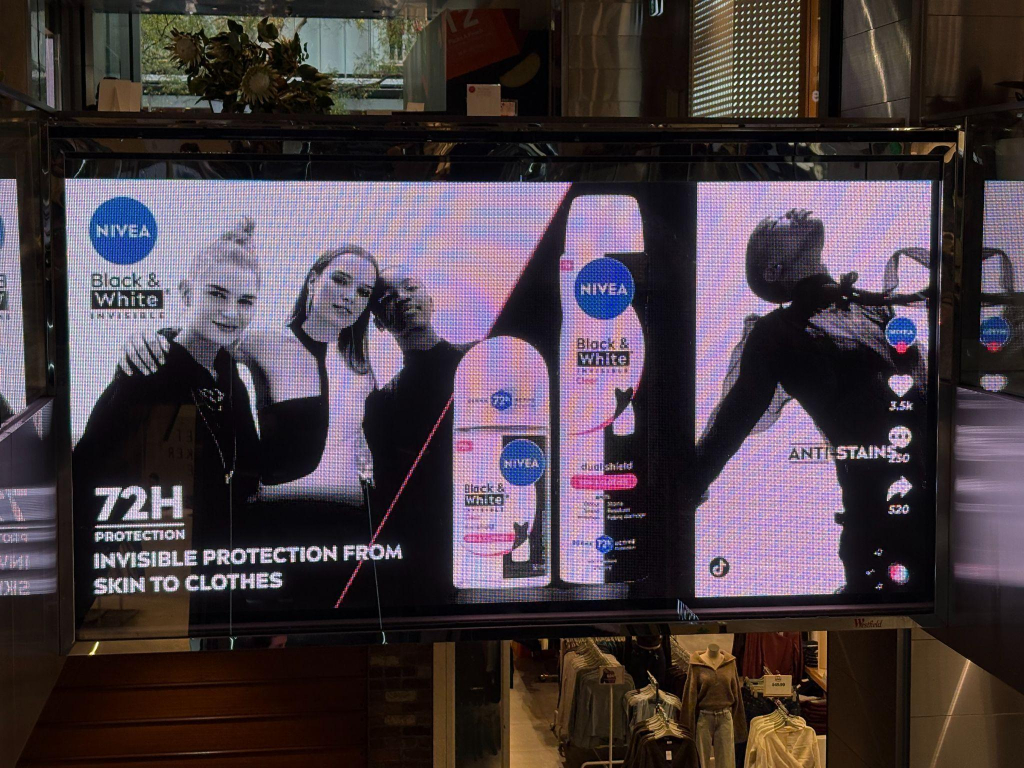
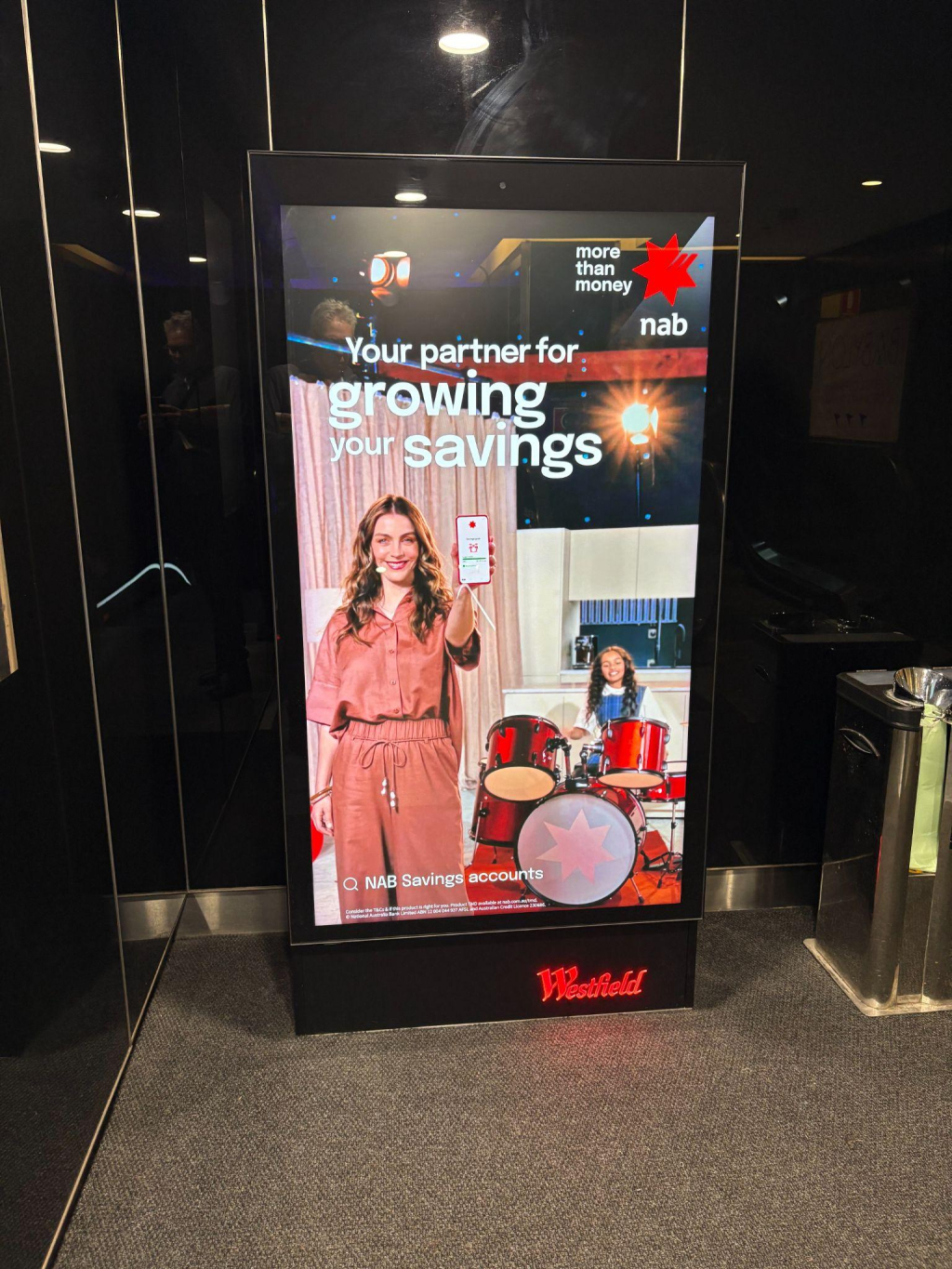
As retail media expands, the conversation is also becoming more commercial. The eTail Australia 2026 Benchmarking Report found that while retailers continue investing in omnichannel capability and growth, many still lack clear visibility into profitability across customer journeys, creating what the report describes as a growing "visibility gap" in modern retail.
Even retailers with established marketplaces have found it difficult to translate that into a scalable retail media model reinforcing that capability, not access, is the real constraint. Retail media doesn't work equally for every business model and applying a generic playbook is where many early strategies fall short.
Why Retail Media Strategies Fail
Retail media doesn't fail because of technology. It fails because of execution.
Too often, retailers build the front-end — ad placements, media packages, campaign offerings — and only later realise the machine behind it isn't ready. Data remains fragmented, governance is unclear, and measurement lacks credibility.
In some cases, revenue is pursued before trust is earned and that trust is far harder to rebuild than it is to delay monetisation.
Retail media sits at the junction of customer data, supplier funding, content, promotions, store experience, and commercial strategy. When those elements are misaligned, performance stalls regardless of how advanced the platform appears.
How to Build a Retail Media Strategy That Works
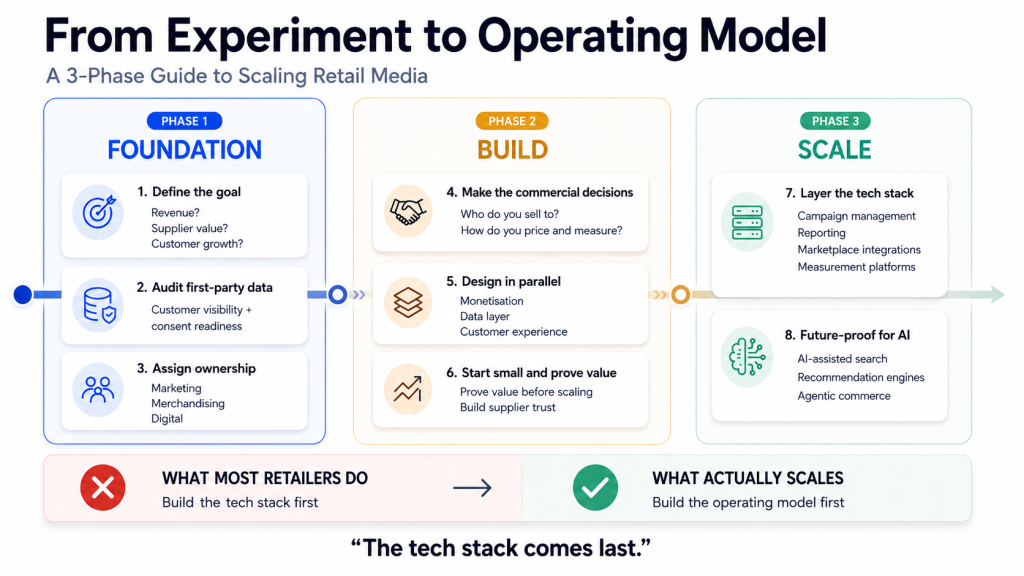
For retail media to deliver meaningful impact, it cannot be treated as a side project. It must be understood as a commercial lever that is owned at board and executive level.
Like omni-channel transformation or marketplace expansion, retail media only realises value when it is treated as a whole-of-business capability. That requires clarity on the business model before scaling, alignment across merchandising, marketing and digital teams, and a deliberate effort to build supplier trust before aggressively pursuing revenue.
The limiting factor is rarely the sophistication of the tools. It is the discipline of the operating model. In practice, retail media success depends on three things: data integration, measurement credibility, and operating model alignment. Without those foundations, even the strongest media proposition will struggle to scale.
The Internal Barrier No One Talks About
The biggest barrier to retail media in Australia isn't external — it's internal.
Many retailers hesitate because they fear retail media will simply redistribute existing supplier income rather than create new value. That concern is rational, particularly in a market where legacy trade funding models are still deeply embedded.
Unlike more mature markets, Australian retailers are often balancing these legacy structures with emerging media models, creating friction in how value is defined, measured, and communicated internally.
Without a clear commercial framework, retail media risks becoming a zero-sum exercise. But when executed well, it can drive category growth, improve visibility, and increase average transaction value.
The real challenge is not access to technology — it is building a credible, internally aligned case for change.
There is also a broader industry dynamic at play. Retailers themselves are often underrepresented in conversations shaping retail media, with much of the dialogue led by agencies, platforms, and supplier brands. As a result, the market risks evolving around external expectations rather than the realities of retail operating models.
Ownership Is the Real Bottleneck
Retail media often sits across marketing, merchandising, and digital functions. Without clear accountability, progress slows.
The most effective models tend to have a single accountable owner, supported by cross-functional governance. Retail media works best when it is treated as a horizontal capability that connects teams, rather than another vertical competing for budget and influence.
Retail Media Measurement: What Brands Actually Expect
Retail media will only scale as far as brands are willing to invest. And increasingly, brands are asking more rigorous questions about value.
They are looking for consistency, transparency, and comparability but more importantly, they are looking for confidence in the numbers they are being shown.
At present, many are still debating metrics rather than making decisions. For example, a supplier might run campaigns across three different retail media networks and receive three different versions of "success": one reporting impressions and clicks, another reporting sales within a short attribution window, and another claiming ROAS based on a broader conversion window. On paper, all three campaigns may look successful. In practice, the brand is left unable to compare performance or understand which investment actually drove incremental growth.
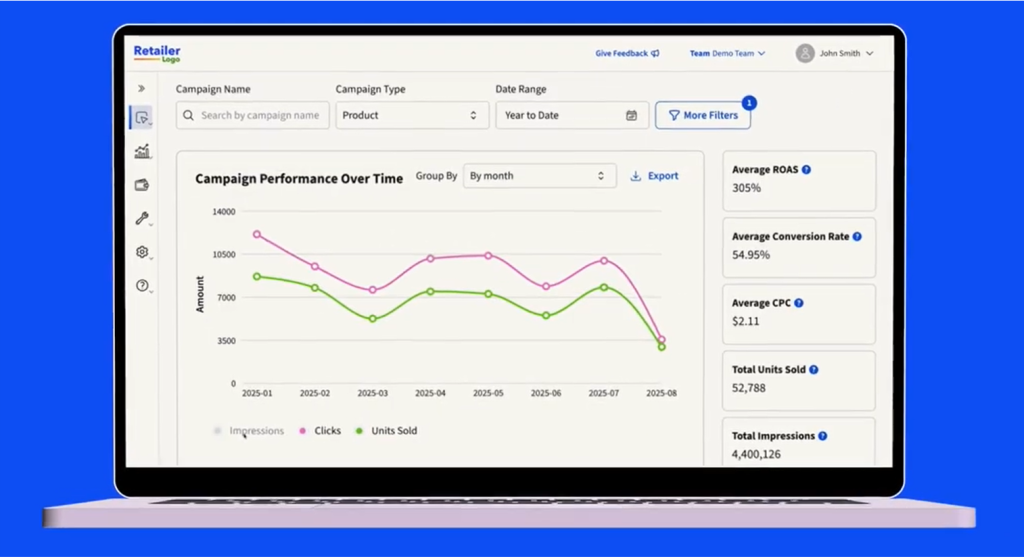
This is why the next phase of retail media in Australia cannot be built on dashboards alone. It requires shared definitions, clearer attribution models, and a stronger commitment to proving commercial impact.
The retailers that pull ahead will be those that move beyond vanity metrics, focus on incrementality, and align their measurement frameworks with real commercial outcomes.
The Future of Retail Media: AI, Discovery and Commerce
The next phase of retail media will not be defined by more placements, but by how commerce itself evolves.
AI and large language models are already reshaping how customers discover products. Increasingly, the journey may not begin on a retailer's website at all, challenging traditional traffic and attribution models.
As AI-assisted shopping and agentic commerce mature, product discovery may be influenced by digital assistants that compare options, filter recommendations, and surface products on behalf of the customer. That changes the role of retail media. The question becomes less about how to win a placement on a page, and more about how to ensure products are discoverable, trusted, and recommended within AI-driven shopping journeys.
Early examples are already emerging locally. Woolworths' AI shopping assistant Olive has become one of the more visible examples of AI-assisted discovery in Australian retail, while Bunnings' conversational assistant Buddy reflects how retailers are starting to rethink product search and customer interaction.
These tools are no longer just experiments. They signal a broader shift toward AI-assisted commerce environments where discovery, recommendation, and eventually retail media become increasingly integrated.
Retail media will shift from static search listings to dynamic, AI-driven recommendations embedded within discovery experiences.
This introduces new requirements around structured product data, machine-readable content, and trusted information. But the real challenge is not experimentation — it is integrating these capabilities at scale without eroding customer trust.
The Split: Who Wins and Who Stalls
Over the next three years, retail media in Australia will split into two paths.
On one side will be retailers that continue to treat it as a yield play — a way to top up revenue without fundamentally changing how the business operates.
On the other will be retailers that embed it as a core operating layer, connecting data, media, and supplier funding to real-world outcomes. Globally, Amazon and Walmart show how far retail media can scale when it is embedded into the commercial model, not treated as a side revenue stream.
The difference will come down to execution. The retailers that demonstrate clear value, build trust with brands, and align internal incentives will pull ahead.
Retail media is not just another channel. It is becoming part of the retail business model.
The retailers that recognise that early will shape the next decade of commerce. Those that don't will be left trying to explain why their investment in retail media never made a meaningful difference.